Budget 2026
|
4 MIN READ
Union Budget 2026: Missed the key announcements? Here’s what matters for EVs, Transport, and Solar
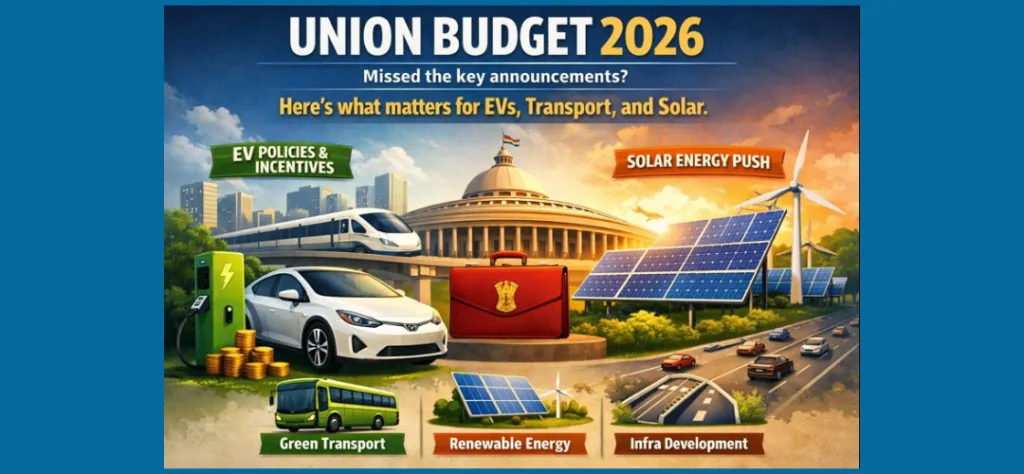
Budget day comes and goes, and suddenly there are hundreds of “key highlights” doing the rounds. Big numbers, mixed reactions, and a lot of discussion around the ideal budget. By the end of it, it’s still hard to tell what actually changed, especially for clean mobility and energy.
If you didn’t follow every announcement, that’s okay. We at TapFin, have gone through the budget and pulled out what’s relevant for EVs, road transport and logistics, and solar.
Let’s start with electric vehicles.
What budget 2026 changed on the ground for Electric Vehicles:
Battery manufacturing and storage
Batteries continue to be the single biggest cost component in EVs. The budget addressed this directly.- Customs duty exemption was extended to capital goods used for lithium-ion battery manufacturing
- The same exemption now applies to equipment used for Battery Energy Storage Systems (BESS)
- This lowers manufacturing costs and improves long-term pricing and ownership economics for EVs
EV supply chains and critical materials
Beyond batteries, the budget also focused on reducing dependence on imported materials.- Support was announced for rare earth and critical mineral development
- Dedicated corridors and processing support aim to strengthen domestic supply chains
- These materials are essential for EV motors, batteries, and power electronics
Public transport and charging ecosystem
EV adoption at scale often starts with public fleets, and this budget continues with that approach.- Ongoing support for electric buses and public EV deployment
- Large fleets help improve charging infrastructure utilisation
- This creates predictable demand for OEMs, operators, and financiers
What this means overall
- EV policy is becoming more execution-driven
- Costs are being addressed at the manufacturing level
- The ecosystem is being prepared for scale rather than quick wins
Strengthening the backbone with road transport and logistics:
Road transport rarely gets the spotlight, but it’s the foundation on which most industries operate. Budget 2026 recognises this and puts meaningful weight behind improving how goods and people move across the country.
What the budget does:
- Boosts allocation on highways and expressways, easing congestion especially around industrial hubs.
- Continues investment in freight corridors and inland waterways, making bulk cargo cheaper and faster to move.
Together, these measures are meant to bring down overall logistics costs, which have long been a challenge for Indian businesses.
For EV fleets, clean energy projects, and large-scale deployments, better road and logistics infrastructure makes execution simpler. Vehicles operate more efficiently, deliveries become predictable, and project timelines are easier to manage.
In practical terms, this part of the budget quietly improves margins, reduces delays, and creates the conditions needed for scale.
Solar Energy — Practical, Reliable, and Cost-Effective
Budget 2026 isn’t just about adding more solar panels. It’s about making solar power dependable and affordable.
- Duty exemptions for solar glass and battery storage cut costs for domestic manufacturers.
- Rooftop and decentralized solar continue to get support.
- Storage-backed solar means power generated during the day can be used later — a game-changer for warehouses, schools, and offices.
Quick cost snapshot for commercial solar + storage:
System Size | Panels | Inverter + Controller | Battery Storage | Installation | Total Approx |
3 kW | ₹1.2–1.5L | ₹40k–₹60k | ₹1.0–1.4L | ₹40k–₹60k | ₹3.0–3.8L |
5 kW | ₹2.0–2.5L | ₹60k–₹90k | ₹1.8–2.5L | ₹60k–₹80k | ₹5.0–6.7L |
*This is a ballpark estimate – exact costs depend on location, components, and incentives. Storage is still the priciest part, but the duty exemptions aim to ease this gradually.
Bottom Line for Indian Businesses
- EVs are getting more practical and cost-efficient at the manufacturing and fleet level.
- Improved roads and freight systems mean smoother operations and better margins.
- Solar + storage is becoming a reliable, cost-effective power option for commercial setups.
Looking for Financing?
Experience the full capabilities of FleetForce through our live dashboard.
Final Thought
Budget 2026 may not feel dramatic, but is majorly about building the foundation for long-term, sustainable growth for your business. By strengthening roads, lowering clean technology costs, and improving energy reliability, it sets up EVs, logistics, and solar for steadier, more sustainable growth.
What are your thoughts on the Budget?
Reach out to us