Credit Score for EV
|
4 MIN READ
Why Battery Health is the New Credit Score for Electric Vehicles
Written by Neha Joshi
4th March 2026
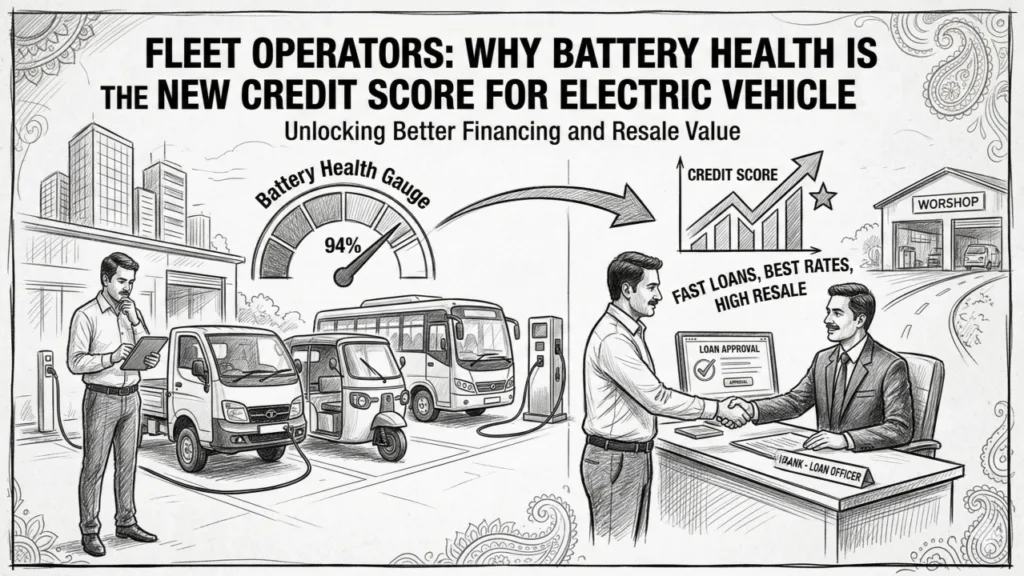
Table of Contents:
- EV Asset Value
- Battery Degradation
- Battery Health
- Battery Transparency
- Loan Structuring
- Battery Health Certificate
- Final Thought
Battery health is no longer just a technical metric – it is increasingly the core determinant of asset value, financing confidence, and resale potential in electric mobility. As EV adoption grows across fleets and commercial operators, lenders are beginning to treat Battery State of Health (SoH) almost like a credit indicator for the asset itself. Here’s how:
1. Battery = 40–45% of EV Asset Value:
In most electric vehicles, the battery represents the single most expensive component.
Typical cost structure:
|
Component |
Share of Vehicle Cost |
|
Battery pack |
40–45% |
|
Motor & power electronics |
20–25% |
|
Chassis & body |
20–25% |
|
Other accessories |
10–15% |
For example:
- Electric 3W / L5 vehicle price: ₹3 – 4 lakh
- Battery pack cost: ₹1.2–1.8 lakh
Because of this, battery degradation directly impacts the underlying collateral value for lenders. Also, the effective asset value declines immediately, affecting both the asset performance and resale value, even if the vehicle body is intact.
2. Battery degradation directly impacts Asset Value:
Lithium-ion batteries degrade over time due to charge cycles, temperature exposure and usage patterns.
Typical degradation benchmarks:
|
Battery SoH |
Impact on Vehicle Value |
|
90–100% SoH |
Near full value |
|
80–90% SoH |
~10–15% value reduction |
|
70–80% SoH |
~25–35% value reduction |
|
<70% SoH |
Limited resale or redeployment value |
Example:
- New 3WEV value: ₹3,50,000
- Battery share: ₹1,40,000
If battery health drops to 75% SoH, lenders assume ~₹50,000 – ₹70,000 reduction in realizable value.
For repossessed vehicles, this difference becomes critical.
3. Why Lenders now care about Battery Health:
Traditionally, lenders evaluated vehicles based on:
- Vehicle age
- Physical condition
- Registration value
But in EV financing, battery condition determines usability and earning potential.
For example, in commercial fleet vehicles:
|
Battery Health |
Range Impact |
Driver Income Impact |
|
100% SoH |
120 km range |
Normal earnings |
|
85% SoH |
~100 km range |
10–15% income drop |
|
70% SoH |
~80 km range |
25–30% income drop |
Lower range reduces trips, directly affecting revenue, which eventually leads to loan repayment capacity.
This is why lenders are starting to integrate battery diagnostics and telematics into underwriting.
4. Secondary market depends on Battery Transparency:
The used EV market is still evolving, and one major barrier is uncertainty around battery life.
In the resale and redeployment of used EVs between fleet operators, lenders, and ecosystem partners:
- Vehicles with verified battery health reports sell 15-25% faster
- Buyers often demand SoH above 80%
- Vehicles without battery diagnostics may see 20-30% lower resale price
For example:
|
Vehicle Condition |
Secondary Market Price |
|
3-year-old 3W EV with 88% SoH |
₹1.9 – 2.1 lakh |
|
Same vehicle with unknown battery health |
₹1.3 -1.6 lakh |
This shows a ₹40k-₹60k value difference driven purely by battery transparency, which is the key insight for lenders and used EV buyers.
Looking for Financing?
Experience the full capabilities of FleetForce through our live dashboard.
5. Impact on Loan Structuring:
Battery health is beginning to influence how loans are structured.
Lenders are exploring:
- Lower LTV for aging batteries:
- New EV LTV: 85–90%
- Used EV with unknown battery health: 60–70%
- Battery-linked underwritingbased on:
- Battery warranty duration
- Charging patterns and cycles
- Battery-as-a-service models
- Vehicle financed separately
- Battery leased or managed
Platforms like TapFin TRUST enable lenders to access battery health reports directly on the platform, with early warnings and actionable insights on usage patterns such as charging cycles and warranty status. Such real-time intelligence allows lenders to structure loans around actual asset performance, significantly reducing NPA risk.
6. The Future: Battery Health Certificates
Just like Credit scores for borrowers, the EV ecosystem is moving toward battery health certificates for assets.
Advanced data analytics platforms such as TapFin FleetForce and TapFin TRUST have been designed with a strong focus on battery analytics, recognizing that battery health is central to EV asset value and financing decisions. Alongside advanced capabilities like vehicle track-and-trace, remote mobilization and immobilization, these platforms provide:
- Telematics-based battery analytics
- BMS diagnostics
- Independent battery inspection reports
These reports can enable:
- Up to 20% faster loan approvals
- Up to 15% better resale valuations
- Lower financing risk
Conclusion
Battery health has quietly become the backbone of EV asset economics.
For lenders, it determines collateral security.
For fleet operators, it determines vehicle earning potential.
For buyers in the secondary market, it determines purchase confidence.
In the electric mobility ecosystem, battery health is no longer a technical metric – it is the financial foundation of the asset itself.
Reach out to us