
|
EV Financing for Lenders: From Disbursement to Portfolio Intelligence
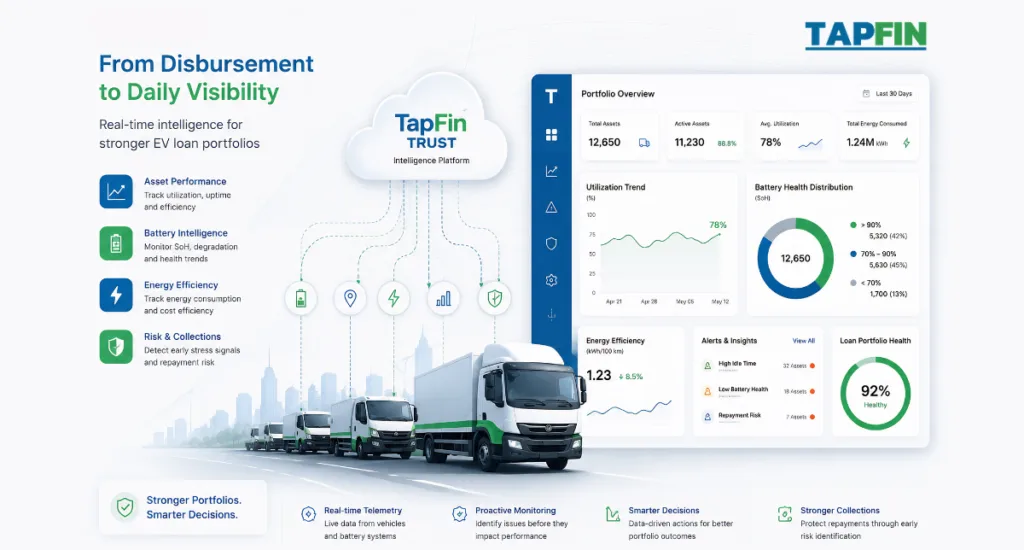
Global disruptions are no longer rare events. They have become recurring structural challenges that impact economies, businesses, supply chains, and everyday mobility.
Rising fuel costs, geopolitical instability, and increasing pressure on energy infrastructure are forcing countries and industries to rethink how mobility assets are financed, deployed, and operated.
In this transition, EV adoption is emerging as a national priority. But adoption alone will not create a long-term impact. The real transformation will happen when the ecosystem shifts from simply financing EVs (like they did for ICE vehicles) to intelligently managing their performance, efficiency, and lifecycle at scale.
And this is where lenders have a critical role to play.
Lenders Are Already Enabling the EV Transition
Across India, financiers and NBFCs have become key drivers of EV adoption.
By enabling access to financing for fleets, drivers, and businesses, lenders are accelerating the shift towards cleaner mobility and reduced fuel dependency.
However, as EV portfolios scale, a new challenge is emerging:
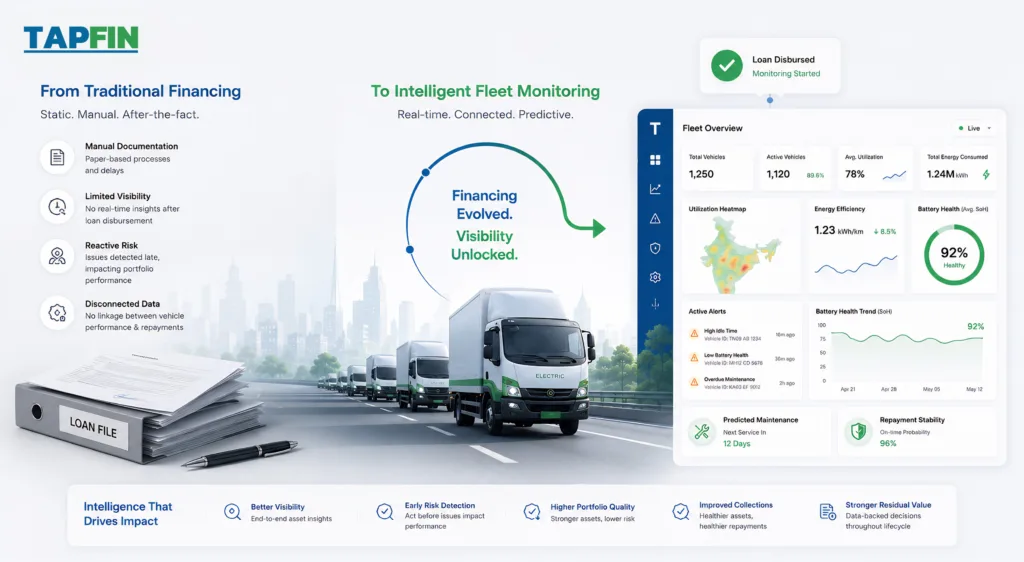
EVs produce data in abundance. And most lenders still have limited visibility into how financed assets perform after disbursement. This is critical, especially for commercial EVs, because the more the asset earns, the more it’s loan repayment capacity.
The Next Phase of EV Financing Must Be Intelligence-Led
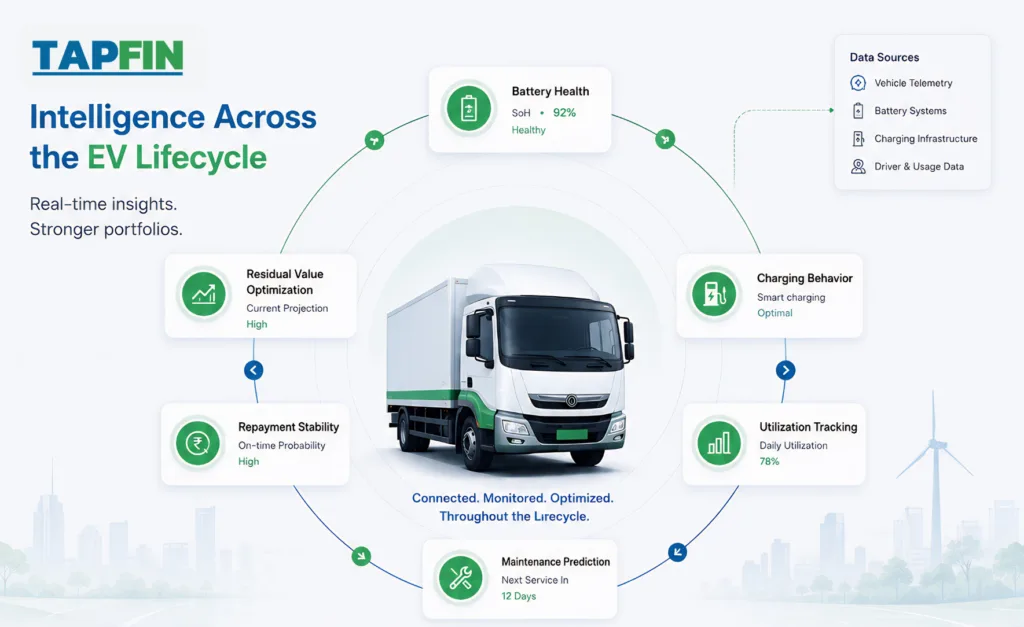
The future of EV financing cannot depend only on credit assessment at origination. It must evolve into continuous portfolio intelligence.
Because every inefficiently operated EV impacts:
- Energy consumption
- Asset life
- Fleet productivity
- Borrower profitability
- Repayment stability
- Residual asset value
At a national scale, these inefficiencies compound into larger economic and energy challenges.
This is why platforms like TapFin TRUST are becoming increasingly important.
Why TRUST Matters in the New Mobility Economy
TRUST was built with a simple belief:
Financing should not stop at disbursement.
Lenders need real-time operational intelligence to proactively monitor, protect, and optimise EV assets throughout their lifecycle.
By connecting vehicle, battery, utilization, and operational data, TRUST enables lenders to move from reactive risk management to proactive portfolio intelligence.
This includes visibility into:
- Battery degradation trends
- Vehicle utilisation patterns
- Energy efficiency behaviour
- Idle-time wastage
- Asset uptime
- Charging behaviour
- Preventive maintenance indicators
- Early stress signals linked to collections and recovery
The result is not only better portfolio performance, but also more efficient energy utilisation across the ecosystem.
Why This Is Bigger Than Individual Portfolios
The EV transition is not only a business opportunity.
It is part of a much larger national transformation.
Every efficiently operated EV contributes towards:
- Reduced fossil fuel dependency
- Lower operational costs
- Improved energy efficiency
- Better asset productivity
- Reduced emissions
- Stronger mobility infrastructure
But achieving country-level impact requires the financial ecosystem to become more proactive, data-driven, and operationally connected.
Lenders now have the opportunity to become more than capital providers.
They can become enablers of intelligent mobility infrastructure. Because in a world shaped by fuel disruptions and energy uncertainty, intelligence-driven efficiency becomes a strategic advantage.
And the institutions that build this visibility early will help shape not only stronger portfolios — but a stronger mobility ecosystem for the country itself.
Need EV asset visibility?
From live tracking to operational risk monitoring, TapFin TRUST helps lenders stay connected to portfolio performance beyond disbursement.
Reach out to us