|
Why are lenders approving borrowers with healthy Credit score and still losing money?
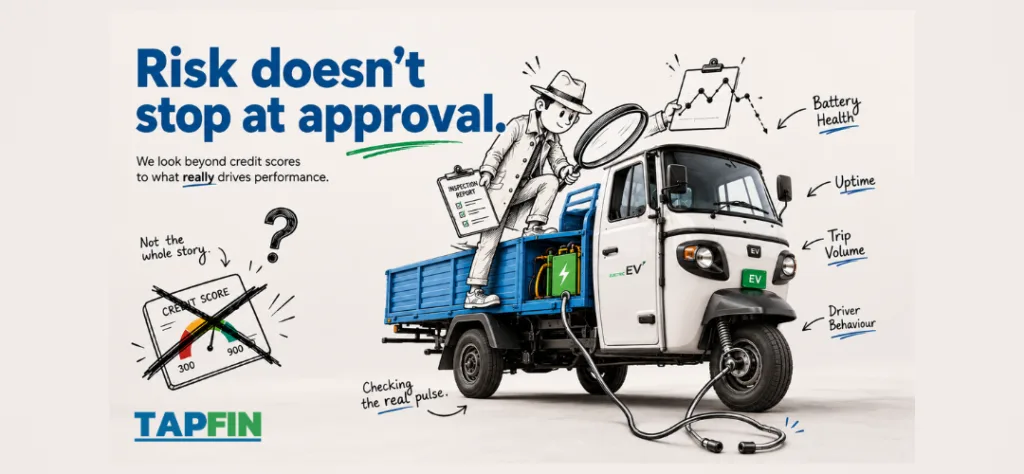
A borrower with a Credit score above 750, stable banking history and a clean repayment record can still become a stressed account within months of loan disbursal.
It is because underwriting captures credit risk at a single point in time, while repayment capacity continues to change throughout the loan cycle. In commercial EV lending, where the financed asset generates the borrower’s income, that distinction matters more than ever.
Underwriting Ends at Origination. Risk Doesn't.
Every lending decision is built on a strong set of fundamentals:
- Credit history
- Repayment behaviour
- Income assessment
- Existing obligations
Together, these help lenders determine whether a borrower is creditworthy at the time of approval. What they cannot determine is whether that borrower will continue generating sufficient cash flow to service the loan over the next six, twelve or twenty-four months.
Commercial EVs Add Another Dimension to Credit Risk
Around 65% of EV financing in India is currently driven by non-bank lenders, while EV loans are typically structured with 3-5 year tenures at interest rates of 10-12%, compared with 5-7 years at 8-9% for ICE vehicles. These differences reflect a market that is still evolving, with greater uncertainty around asset performance and residual values.
For lenders, repayment capacity is influenced by factors that do not appear in a bureau report, including:
- Vehicle utilisation
- Battery health
- Downtime
- Trip volumes
- Maintenance history
When the asset’s earning capacity declines, repayment risk usually follows.
As Portfolios Grow, Monitoring Becomes the Challenge
Vehicle finance AUM in India is projected to grow at 15-17% annually through FY2027, with the pre-owned segment expected to account for more than 41% of NBFC vehicle finance portfolios.
As books grow, the challenge shifts from underwriting individual loans to monitoring thousands of active ones. A borrower approved six months earlier may now be operating a vehicle with declining utilisation, increasing downtime or weakening earnings, yet those changes are unlikely to appear in periodic portfolio reviews. Without continuous visibility, lenders often identify deteriorating accounts only after repayment performance has already been affected.
Closing the Gap: What TRUST Adds
Traditional underwriting establishes whether a borrower was creditworthy at the time of approval. Commercial EV portfolios also require visibility into whether financed assets continue generating enough economic activity to sustain repayment throughout the loan lifecycle.
TRUST helps lenders bridge that gap by enabling them to:
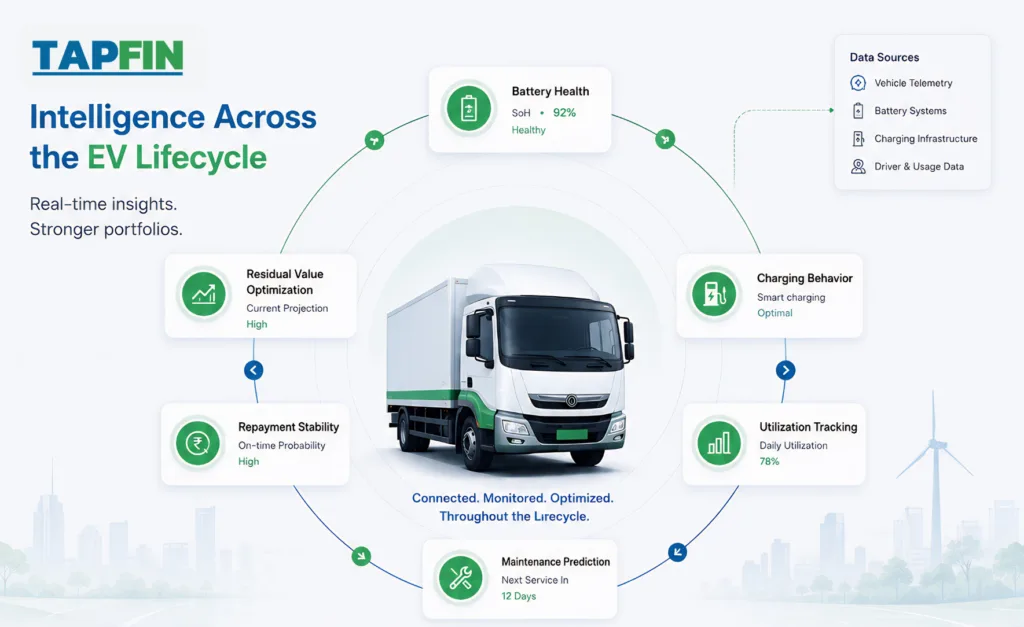
- Combine financial data and operational intelligence through a unified TapFin Stress Score.
- Continuously monitor utilisation, uptime and battery health across financed assets.
- Ingest operational data from multiple OEMs, IoT platforms and Battery Management Systems (BMS).
- Detect deteriorating accounts early through portfolio-level risk dashboards and early-warning indicators.
Commercial EV lending is gradually shifting from static credit assessment to continuous portfolio intelligence. Lenders that combine traditional underwriting with operational asset visibility will be better positioned to identify emerging risk early, strengthen portfolio quality and make more informed lending decisions over the life of a loan.
Need EV asset visibility?
From live tracking to operational risk monitoring, TapFin TRUST helps lenders stay connected to portfolio performance beyond disbursement.
Reach out to us