|
Used EVs in India: The complete guide to buying used EVs & understanding battery value
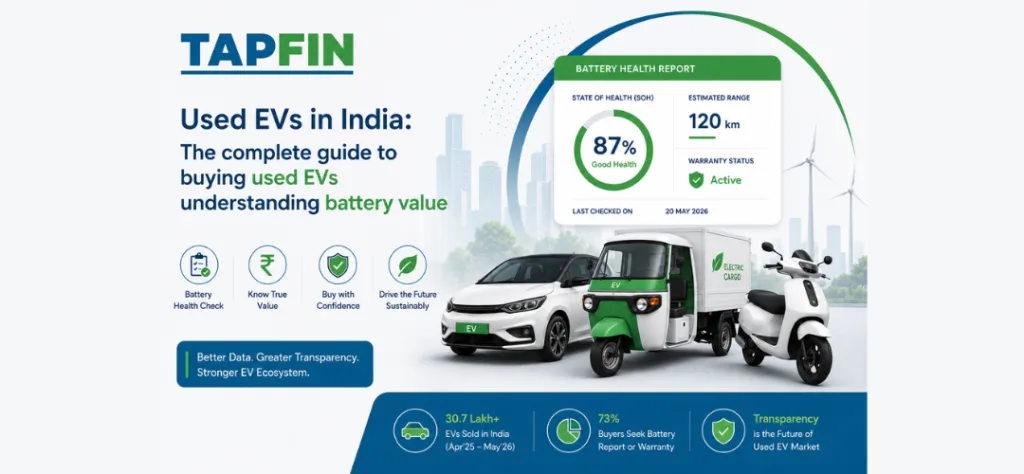
India’s EV market is growing rapidly.
Between April 2025 and May 2026, more than 30.7 lakh electric vehicles were sold across the country, accelerating EV adoption across both personal and commercial segments. Yet when you look at the used vehicle market, the numbers tell a very different story.
Despite millions of EVs on Indian roads today, only a few hundred used electric scooters and electric cars are actively listed across the used electric vehicles market today.
Given the typical lifecycle of an EV, especially in the two-wheeler and three-wheeler space and the battery space, a significantly larger number of vehicles should already be entering the used EV market through resale, refurbishment, battery replacement, repurposing, or recycling channels.
This mismatch is raising important questions in the used EV ecosystem:
- Where are all these ageing EVs?
- How can buyers accurately assess their value when they do enter the market?
- How long does an EV battery last?
- How to check EV battery health?
- Is buying a used EV worth it?
- How much does an EV battery cost?
- EV battery replacement cost
- Should I buy a second hand electric scooter?
- Used EV buying guide
- How to value a used EV?
- What happens to EV batteries after use?
- How much does battery degradation affect range?
The reason isn’t a lack of demand. It’s a lack of confidence.
Unlike petrol and diesel vehicles, where buyers can evaluate mileage, engine condition, and service history, the most expensive component of an EV is far harder to assess.
The battery.
For most EVs, the battery accounts for 30-40% of the vehicle’s value. Yet many buyers and sellers still don’t have a standardized way to understand their condition.
In this guide, we explore the current state of India’s used EV market, why battery health matters, and what buyers, sellers, financiers, and fleet operators need to know to accurately determine an EV’s real value.
Summary of market for Electric Vehicles in India:
| Metric | 2026 Snapshot |
| EVs sold in India (April 2025-May 2026) | 30.7 lakh+ |
| Used EV cars listed on CarDekho | 498 |
| Used EV listings across OLX (2W, 3W & 4W) | 2,416+ |
| Used EV cars listed in Delhi alone | 291 |
| Buyers seeking battery certification or warranty | 73% |
EV adoption is growing fast, but transparency and trust in used EV transactions have yet to scale at the same pace.
How to value a used EV?
A two-year-old petrol vehicle and a two-year-old EV may look similar on paper.
The difference is hidden beneath the floorboard.
While buyers can estimate the condition of an engine through servicing records and inspection, battery degradation isn’t always visible.
This has created a valuation gap across the used EV market.
Vehicle Type | Average Depreciation After 2 Years |
Petrol Car | ~20% |
Electric Car | ~42% |
Petrol Scooter | 30-40% |
Electric Scooter | 50-60% |
A major reason for this difference is battery uncertainty.
When buyers cannot confidently estimate remaining battery life, they naturally reduce the price they’re willing to pay.
How much does battery degradation affect range?
Before discussing price, financing, or ownership transfer, ask for a Battery State of Health (SoH) Report.
Think of it as a health check-up for the battery.
It shows how much usable battery capacity remains compared to when the vehicle was new.
Battery SoH | What It Means |
Above 90% | Excellent battery condition |
85-89% | Good condition |
80-84% | Negotiate carefully |
Below 80% | High risk |
If a seller cannot provide a recent SoH report, arrange a battery inspection through an authorized service centre before proceeding.
A vehicle’s appearance can be restored.
NOT the Battery health.
Follow this checklist to buy commercial used electric vehicles in India:
Before making a purchase, verify the following:
Checkpoint | Why It Matters |
Battery SoH Report | Indicates remaining battery health and expected performance |
Warranty Transferability | Can reduce future battery replacement risk |
Real-World Range Test | Helps validate actual range against claims |
Charging History | Frequent DC fast charging may accelerate degradation |
Service Records | Shows maintenance history and repairs |
Undercarriage Inspection | Identifies possible battery casing damage |
Red flags you shouldn’t ignore
Warning Sign | Potential Risk |
No SoH report available | Battery condition cannot be verified |
Missing service records | Unknown maintenance history |
Non-transferable battery warranty | Higher ownership risk |
SoH below 80% | Potential battery replacement in coming years |
Actual range significantly below claimed range | Possible degradation issues |
Why used EV financing is still expensive
One challenge often overlooked is financing.
New EV loans are generally available at lower interest rates than used EV loans.
The reason comes back to battery valuation.
Lenders understand vehicle age, mileage, and ownership history. What remains difficult to assess consistently is battery health and remaining useful life.
Without standardized battery data, lenders price additional risk into financing decisions.
This is one reason industry stakeholders are increasingly discussing battery health certificates and residual value frameworks as key building blocks for the next phase of EV growth.
How the market Is evolving
OEMs and ecosystem players have started introducing programs designed to improve confidence in used EV transactions.
Examples include:
- Certified pre-owned EV programs
- Battery health assessments
- Assured buyback initiatives
- Extended battery warranties
- Digital vehicle history records
These initiatives are helping create greater transparency around battery condition and residual value.
TapFin Xchange – the marketplace for used electric vehicles:
At TapFin, we believe the future of used vehicle transactions will be driven by better data and greater transparency.
Through TapFin Xchange, we are working to simplify vehicle resale by connecting buyers, sellers, fleet operators, financiers, and ecosystem partners on a single platform.
Whether you’re looking to buy, sell, finance, or evaluate a vehicle, access to reliable information around vehicle condition, ownership history, and battery performance can help stakeholders make more informed decisions.
Looking for a used commercial EV?
TapFin Xchange helps buyers discover pre-owned vehicles while providing greater visibility into vehicle history, condition, and ownership information.
Reach out to us